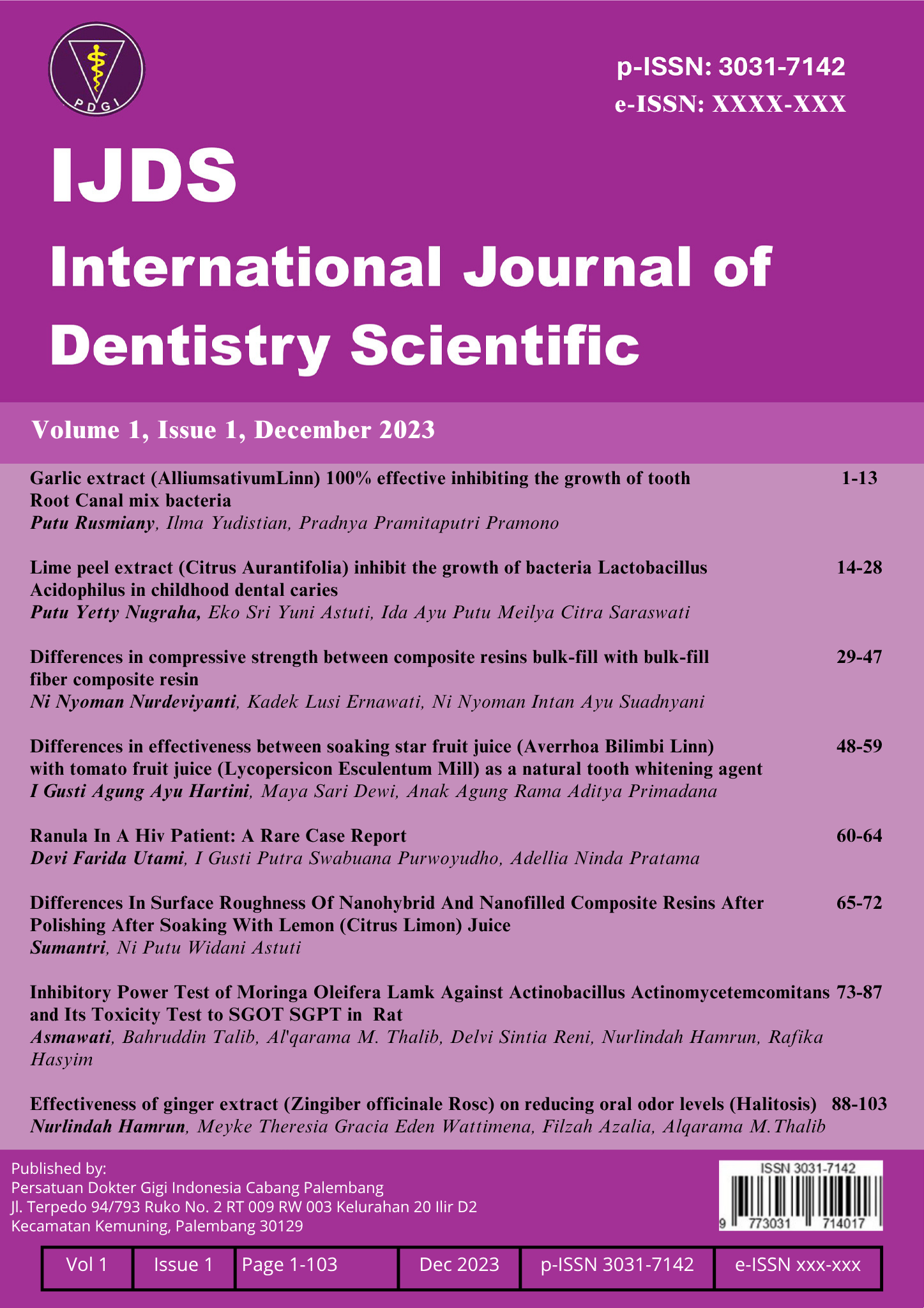
Differences in compressive strength between composite resins bulk-fill with bulk-fill fiber composite resin
Main Article Content
Abstract
Text size
Dental and oral health problems in Indonesia are currently quite high, one of the most common dental and oral diseases is dental caries. Teeth that have been affected by caries need special attention to be treated. Considerations in selecting the filling material also need to be taken into account so that it has the ability to withstand large chewing loads and does not fracture easily. Restoration materials that are good and can restore aesthetic function are what society needs, one of these materials is composite resin. This composite resin can be applied directly into the cavity and its color can resemble natural teeth. to determine the difference in compressive strength between bulk-fill composite resin and bulk-fill fiber composite resin. The research used was laboratory experimental with a post-test only design. This research involved 2 composite resins, namely bulkfill composite resin as group I and bulkfill fiber composite resin as group II. Samples with a cylindrical tube shape have a diameter of 4 mm and a height of 6 mm, 10 samples per group, then the samples are soaked in distilled water and then placed in an incubator at a temperature of 37⁰ for 24 hours. This was followed by each sample being tested for compressive strength using a Universal Testing Machine until it was crushed. Group I compressive strength was 223.28 Mpa and Group II was 403.9 Mpa. Data analysis used the parametric independent t-test with p = 0.00 where p < 0.05, which means the difference in compressive strength obtained was significant between bulkfill composite resin and bulkfill fiber. the compressive strength of bulkfill fiber composite resin is greater than bulkfill composite resin.
Article Details
Article Sidebar
Download this PDF file
PDFPublished:
December 2, 2
Section
Articles
License

This work is licensed under a Creative Commons Attribution 4.0 International License.
How to Cite
Differences in compressive strength between composite resins bulk-fill with bulk-fill fiber composite resin. International Journal of Dentistry Scientific, 1(1). https://ijdsapplied.org/ijds/article/view/4